Iwagumi Layout Guide
Master the Japanese art of stone arrangement — minimalism, balance, and natural tension.
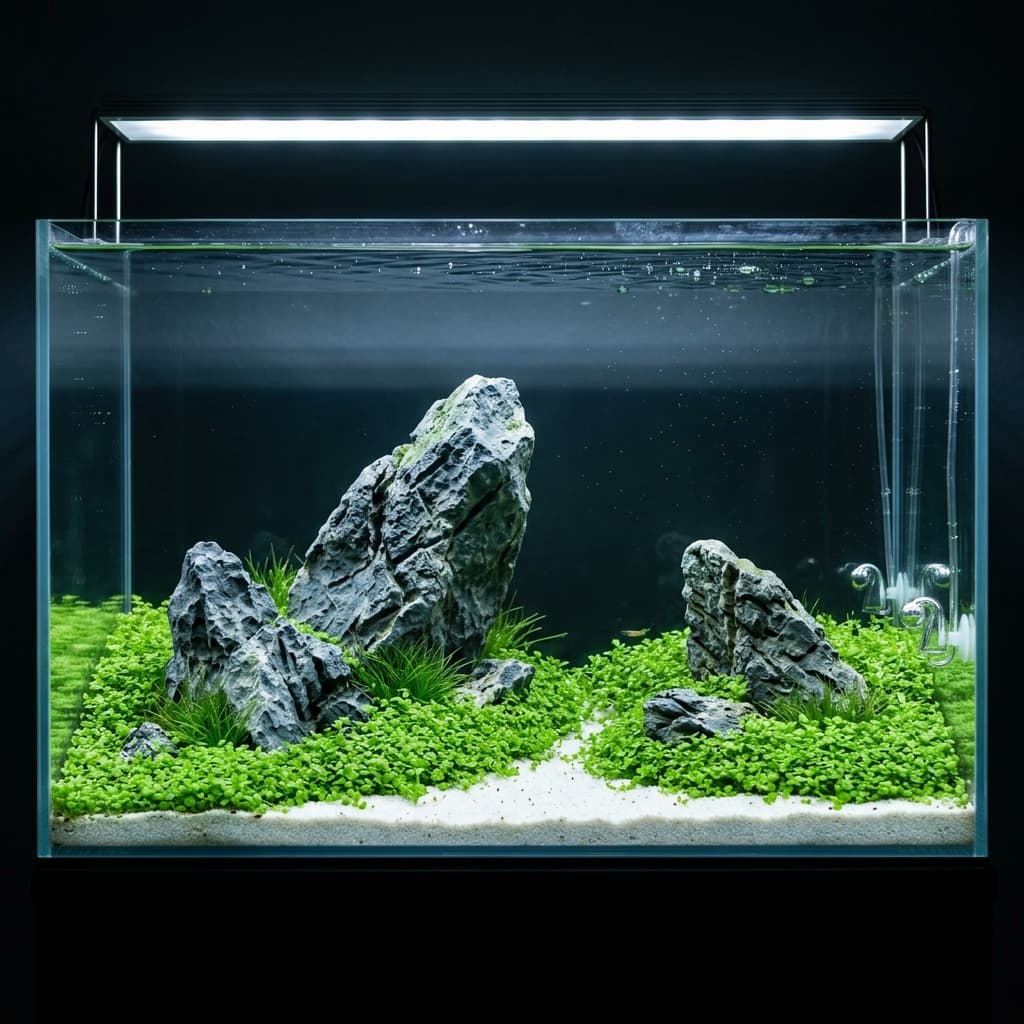
Iwagumi is the most minimalist and arguably most difficult aquascaping style. Developed by Takashi Amano, it uses only rocks and low-growing plants to create a serene, zen-like landscape. The challenge? With so few elements, every placement matters.
The Rule of Odd Numbers
Iwagumi layouts always use an odd number of stones — typically 3, 5, or 7. Each stone has a role: the Oyaishi (main stone) is the largest and most dramatic, placed off-center. The Fukuishi (secondary stone) complements the main. The Soeishi (accent stones) add balance and depth.
Stone Selection & Placement
Use one type of stone throughout. Seiryu stone and Ryuoh stone are classics. All stones should share the same grain direction and angle — as if they were once a single rock that naturally eroded apart. Bury stones 1/3 into the substrate to make them look naturally grounded, not placed.
Plant Selection
Iwagumi uses only 1-3 plant species, typically carpet plants: Glossostigma, Monte Carlo, Eleocharis (Dwarf Hair Grass), or Hemianthus callitrichoides (HC Cuba). The simplicity is intentional — the stones are the art, the carpet is the canvas.
CO₂ & Lighting
Most Iwagumi layouts require CO₂ injection and high lighting to grow a dense carpet. This is non-negotiable for species like HC Cuba. Budget 6-8 hours of strong light daily and maintain CO₂ at 30ppm during the photoperiod.